How to Convert Your CGPA to Percentage: A Step-by-Step Guide
If you’ve ever wondered how to convert your CGPA (Cumulative Grade Point Average) to a percentage, you’re not alone. Many universities and employers use percentage scores for assessments, job applications, and academic eligibility. Understanding how to convert your CGPA to percentage is essential for presenting your academic performance in a universally recognized format.
In this step-by-step guide, we’ll walk you through:
- What CGPA is and why it’s important
- How to convert CGPA into percentage
- The formula used in different universities
- Practical examples with CGPA values
- Common mistakes to avoid
- A detailed FAQ section to clear all doubts
By the end, you’ll be able to confidently convert your CGPA to percentage for any academic or professional purpose.
1. Understanding CGPA and Its Significance
Before diving into the conversion process, it’s important to understand what CGPA is and how it’s calculated.
What is CGPA?
CGPA stands for Cumulative Grade Point Average. It’s the weighted average of grade points earned across all semesters or courses throughout your academic program. Unlike SGPA (Semester Grade Point Average), which measures performance for a single semester, CGPA reflects your overall academic performance throughout your course.
The Grading Scale
CGPA is typically calculated on a scale of 0 to 10, where 10 represents the best possible grade (usually an “A” or equivalent), and 0 represents failure.
The formula for calculating CGPA is generally as follows:
CGPA=∑(Grade Points×Credits of Courses) / ∑(Credits of all Courses)
It’s a weighted average, meaning more important courses (with higher credits) contribute more to your CGPA.
2. Why Convert CGPA to Percentage?
Universality of Percentage
While CGPA is a common grading system in universities, many employers and educational institutions (especially in countries like India) prefer percentage marks to evaluate academic performance. Converting your CGPA into a percentage is useful when you:
- Apply for jobs where employers prefer percentage marks
- Apply for further studies or scholarships that require percentage-based scoring
- Need to compare your performance to other students who follow a percentage grading system
3. The Conversion Formula — Different Universites, Different Methods
There isn’t a universal method to convert CGPA into percentage. Different universities use slightly different formulas based on their grading system. Below are some common formulas:
3.1 Common Conversion Formula
Many universities follow the basic formula:
Percentage=CGPA×10
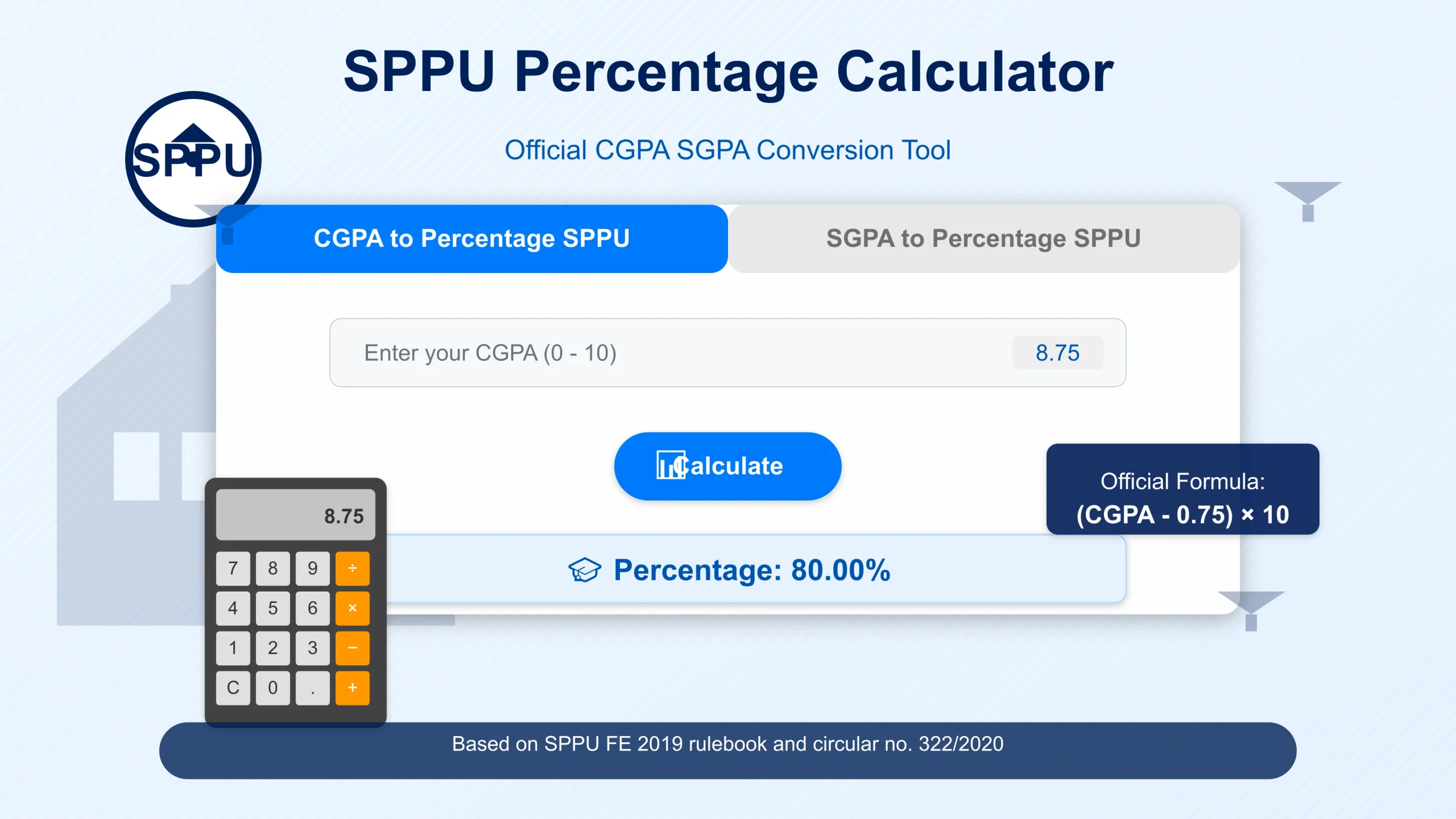
This is the most common formula used by many universities worldwide. For instance, Delhi University, University of Mumbai, and University of Pune follow this formula for CGPA to percentage conversion.
Example:
If your CGPA is 8.5:
Percentage=8.5×10=85%
3.2 Alternate Formula Used by Some Universities
Some universities may use a slightly modified formula that involves subtracting a constant from CGPA. For example, the formula may be:
Percentage=(CGPA×9.5)\text{Percentage} = (\text{CGPA} \times 9.5)
So, your 8.5 CGPA is equivalent to an 85%.
Percentage=(CGPA×9.5)
This is common in universities like Anna University and APJ Abdul Kalam Technological University (KTU) for their undergraduate programs. The multiplication factor (9.5) is used to adjust for the differences in grading scales.
Example:
If your CGPA is 8.5:
Percentage=8.5×9.5=80.75%
So, using this formula, your CGPA of 8.5 equals 80.75%.
4. Step-by-Step Guide: How to Convert Your CGPA to Percentage
Let’s now look at a step-by-step process you can follow to convert your CGPA into percentage.
Step 1: Check the Formula for Your University
Before you start calculating, it’s essential to determine which formula applies to your university or institution.
- If your institution uses a direct multiplication by 10, you’ll use the simple formula (CGPA × 10).
- If your institution follows a multiplication by 9.5 or any other factor, ensure you use that formula.
Step 2: Find Your CGPA
Your CGPA is the cumulative score you’ve achieved across all completed semesters. You can find it in your transcripts or semester report cards.
Step 3: Apply the Formula
Once you know the formula for your university, plug your CGPA into the correct formula.
For direct multiplication (CGPA × 10): Multiply your CGPA by 10.
For CGPA × 9.5: Multiply your CGPA by 9.5.
Example 1: University with CGPA × 10
If your CGPA is 7.2 and the formula is CGPA × 10, the percentage would be:
Percentage=7.2×10=72%
Example 2: University with CGPA × 9.5
If your CGPA is 7.2 and the formula is CGPA × 9.5, the percentage would be:
Percentage=7.2×9.5=68.4%
Step 4: Double-Check Your Work
Ensure you’ve applied the correct formula, especially if you’re converting CGPA from multiple institutions or sources. It’s always good to round your final percentage to the nearest whole number (unless specified otherwise).
5. Common Mistakes to Avoid When Converting CGPA to Percentage
Here are some common mistakes students make when converting their CGPA into percentage:
Mistake 1: Using the Wrong Formula
As mentioned, not all universities use the same formula. Always confirm the correct conversion method for your university before calculating.
Mistake 2: Confusing CGPA with SGPA
CGPA represents your cumulative score over multiple semesters, while SGPA is specific to a single semester. Converting SGPA to percentage is a different process.
Mistake 3: Incorrectly Rounding Numbers
Ensure your rounding method is appropriate. Some institutions may require you to provide the full decimal, while others may ask for a rounded figure.
Mistake 4: Failing to Convert to a Common Scale
If your university uses a non-standard grading scale (e.g., CGPA out of 4), make sure to convert to the standard CGPA scale (0‑10) first, if applicable.
6. FAQ’s
Q1. Why do some universities use a factor like 9.5 or 10 for CGPA to percentage conversion?
A: The multiplication factor compensates for differences in grading systems between universities. It ensures the converted percentage aligns better with marks-based systems.
Q2. Can I convert my CGPA to percentage for a job or university application?
A: Yes, many employers and universities ask for a percentage. It’s important to follow the correct conversion formula used by your institution.
Q3. Is a higher CGPA always equal to a higher percentage?
A: Yes, a higher CGPA generally means a higher percentage. However, the percentage may vary depending on the conversion formula used by different universities.
Q4. Do I need to convert my SGPA to percentage too?
A: If you’re applying for something that requires your semester results, you may need to convert your SGPA. But for overall academic performance, CGPA is usually more important.
7. Conclusion
Converting your CGPA to percentage is an essential skill for students applying for jobs, scholarships, or higher education. Whether your institution uses a formula like CGPA × 10 or CGPA × 9.5, it’s important to follow the correct steps to ensure your academic performance is accurately represented.
Always double-check your conversion formula, apply it carefully, and avoid common mistakes. Now that you understand the process, you can confidently convert your CGPA to percentage and present your grades effectively.
8. Bonus: CGPA to Percentage Conversion Chart
| CGPA | Formula (CGPA × 10) | Formula (CGPA × 9.5) | Percentage (%) |
| 8.5 | 8.5 × 10 = 85% | 8.5 × 9.5 = 80.75% | 80.75% |
| 7.2 | 7.2 × 10 = 72% | 7.2 × 9.5 = 68.4% | 68.4% |
| 9.0 | 9.0 × 10 = 90% | 9.0 × 9.5 = 85.5% | 85.5% |